
Past workshops:
HASP 2025HASP 2024
HASP 2023
HASP 2022
HASP 2021
HASP 2020
HASP 2019
HASP 2018
HASP 2017
HASP 2016
HASP 2015
HASP 2014
HASP 2013
HASP 2012
Past workshops:
HASP 2025Security and privacy research focusing on hardware and architecture aspects has become increasingly important. In the era of cloud computing, smart devices, and novel nano-scale devices, practitioners and researchers have to address new challenges and requirements in order to meet the ever-changing landscape of security research and new demands from consumers, enterprises, governments, defense, and other industries.
HASP is intended to bring together researchers, developers, and practitioners from academia and industry, to share practical implementations and experiences related to all aspects of hardware and architectural support for security and privacy, and to discuss future trends in research and applications. To that end, papers are solicited from areas including, but not limited to:
Authors can submit the following types of papers:
Submission Deadline: Aug. 10, 2026 Aug. 17, 2026 (final extended deadline) by end of day Anywhere on Earth (AoE)
Notification of Acceptance: Sep. 16, 2026
Camera-Ready Version: Oct. 1, 2026
Physical Workshop: Oct. 31, 2026 (in conjunction with MICRO 2026)
All submissions must use the double-column ACM ICPS template. LaTeX template is preferred. Please use the ACM Standard template in the usual two-column format. The template can be found here.
The submissions should be anonymized for double-blind review.
Regular submissions (Research paper, SoK, position paper) must be at most 7 pages excluding the bibliography and appendices (these papers may be recommended for acceptance as short 4-page papers during the review process, but full-length papers should be initially submitted if authors want to be considered for a full-length paper publication). Short papers (Research paper, WiP) must be at most 4 pages excluding the bibliography and appendices.
All accepted research papers, SoK papers, and position papers will be included in the ACM Digital Library; WiP papers are not included. The proceedings will be published through ACM ICPS following the open access model and available through the ACM Digital Library. Read more in the open access section at the end of this page.
Papers can be submitted at: https://hasp26.cs.rochester.edu/
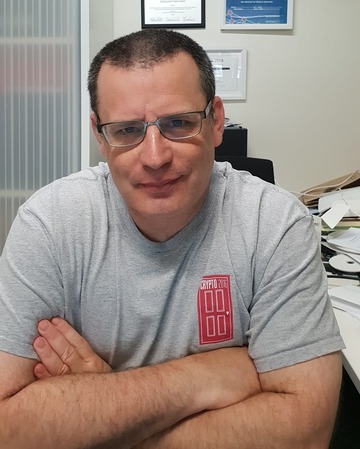
Yuval Yarom is a Professor of Computer Security at Ruhr University Bochum. His research focuses on the interface between the software and the hardware. In particular, he is interested in the discrepancy between the way that programmers think about software execution and the concrete execution in modern processors. Previously, he has been an Associate Professor at the University of Adelaide, the Vice President of Research in Memco Software, and a co-founder and Chief Technology Officer of Girafa.com. Yuval earned his Ph.D. in Computer Science from the University of Adelaide in 2014, and an M.Sc. in Computer Science and a B.Sc. in Mathematics and Computer Science from the Hebrew University of Jerusalem in 1993 and 1990, respectively.

Stefan Saroiu is a researcher in the Software-Hardware Co-design Research Group at Microsoft Research. His research interests cover many aspects of systems and networks, although his recent work has primarily focused on hardware and systems security. Stefan's work has been published at top conferences in the fields of security, systems, networking, and mobile computing. Stefan takes his work beyond publishing results. With his colleagues at Microsoft, he (1) designed Sigries, a Rowhammer defense built in the Azure Cobalt 200 SoC (Microsoft 1P silicon), (2) designed Panopticon, a Rowhammer defense adopted by the DRAM industry, (3) designed, deployed, and operated Microsoft Embedded Social, a cloud service aimed at user engagement in mobile apps, which had 20 million users, (4) created the reference implementation of a firmware-based Trusted Platform Module (fTPM) used in hundreds of millions of smartphones and tablets, and (5) designed and operated Zero-Effort Payments (ZEP), one of the first face recognition-based payment systems in the world. Before joining Microsoft in 2008, Stefan spent three years as a faculty member in the Computer Science Department at the University of Toronto, and four months as a visiting researcher at Amazon.com, where he contributed to the early designs of their new shopping cart system, known as Dynamo. Stefan has a PhD from the University of Washington where he was advised by Steve Gribble and Hank Levy. Stefan is an ACM Fellow.
HASP 2026 will also organize a mentoring program, which provides student attendees opportunities to get connected with senior researchers individually, and have conversations about their research and career. They will be paired up with faculty/postdoc mentors for meetings during the workshop/conference, and any follow-ups afterward.
Important update on the new ACM open access publishing model for ICPS!
ACM has introduced a new open access publishing model for the International Conference Proceedings Series (ICPS). Authors based at institutions that are not yet part of the ACM Open program will be required to pay an article processing charge (APC) to publish their ICPS article in the ACM Digital Library, unless one of their co-authors' institutions is a member or they qualify for a waiver. To determine whether or not an APC will be applicable to your article, please follow the detailed guidance here: https://www.acm.org/publications/icps/author-guidance.
Further information may be found on the ACM website: